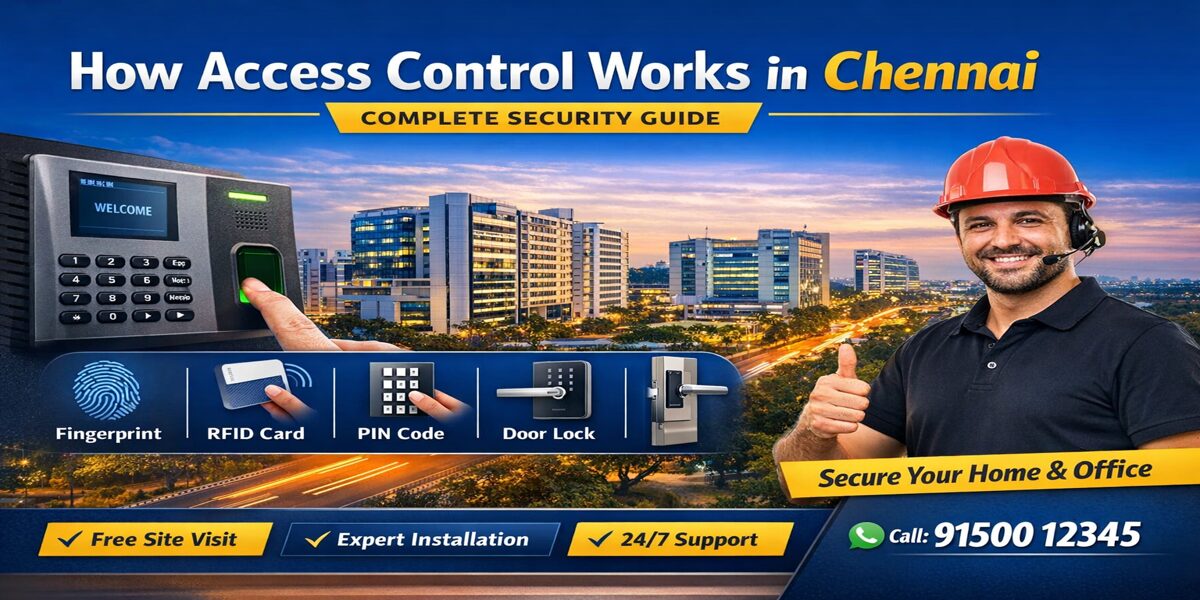
How Access Control Works: Complete Guide for Homes, Offices & Businesses in Chennai
Understanding How Access Control Works is important before investing in any security solution. Whether you manage an apartment, office, factory, school, or villa, the right access control system improves security, reduces unauthorized entry, and simplifies monitoring.
Modern buildings in Chennai are rapidly shifting toward smarter security systems. From gated communities in Anna Nagar to IT offices in OMR and commercial buildings in T. Nagar, access control systems are becoming essential for safety, workforce management, and operational efficiency.
This guide explains how access control systems function, their types, benefits, biometric integration, role-based access models, pricing factors, and why businesses in Chennai are adopting them at scale.
What Is an Access Control System?
An access control system is a security solution that regulates who can enter or exit a specific area, building, or room.
Instead of traditional locks and keys, modern systems use:
- RFID cards
- Fingerprint scanners
- Face recognition
- PIN codes
- Mobile app access
- Cloud authentication
The system verifies identity before granting access.
In simple terms, access control ensures:
- Authorized people can enter
- Unauthorized people are blocked
- Every entry and exit is recorded
This improves security, accountability, and operational control.
How Access Control Works
Understanding How Access Control Works begins with the authentication process.
A standard access control system consists of:
- Credential Input Device
- Controller
- Authentication Database
- Door Lock Mechanism
- Monitoring Software
Step-by-Step Process
1. User Presents Credentials
The user scans:
- Fingerprint
- RFID card
- PIN
- Face ID
- Mobile QR code
This is the first verification stage.
2. Controller Verifies Identity
The access controller checks whether the credential exists in the database.
It compares:
- User ID
- Permission level
- Access timing
- Area authorization
3. Access Permission Is Evaluated
The system decides:
- Allow entry
- Deny entry
- Trigger alerts if suspicious
Permissions may depend on:
- Employee designation
- Working hours
- Department
- Visitor status
4. Door Unlocks
If verified, the electronic lock opens automatically for a few seconds.
Common lock types:
- Magnetic locks
- Electric strikes
- Smart locks
5. Entry Logs Are Stored
Every action is recorded:
- Time
- User name
- Door location
- Access result
This creates a complete audit trail.
How Biometric Access Control System Works
Biometric access control systems identify individuals using unique biological characteristics.
Common biometric technologies include:
- Fingerprint recognition
- Facial recognition
- Iris scanning
- Palm vein scanning
Biometric Verification Process
Fingerprint Capture
The scanner reads fingerprint patterns.
Template Matching
The system converts the fingerprint into encrypted digital data.
Database Comparison
Stored biometric templates are matched.
Access Decision
If the match is successful, access is granted.
Logging & Monitoring
The event is saved for future audits.
Biometric systems are highly popular in:
- IT companies
- Factories
- Data centers
- Schools
- Hospitals
- Corporate offices in Chennai
Why Chennai Businesses Are Adopting Access Control Systems
The demand for smart security systems in Chennai is increasing due to:
- Rising commercial infrastructure
- Apartment security concerns
- Workforce automation
- Visitor management needs
- Compliance requirements
Areas like:
- OMR
- Velachery
- Anna Nagar
- Porur
- Tambaram
- Guindy
- T. Nagar
are seeing rapid adoption of biometric and RFID access systems.
Chennai-Specific Advantages
Power-Efficient Operation
Modern systems consume minimal electricity, ideal for Chennai offices managing energy costs.
Weather-Resistant Hardware
Humidity-resistant devices perform better in Chennai’s coastal climate.
Better Apartment Security
Gated communities benefit from:
- Visitor tracking
- Delivery management
- Clubhouse access control
Faster Employee Attendance
Biometric integration improves HR efficiency.
Main Types of Access Control Systems
Different buildings require different security models.
1. Discretionary Access Control (DAC)
The owner decides who gets access.
Best for:
- Small offices
- Retail shops
- Independent cabins
Advantages
- Simple setup
- Flexible permissions
Limitation
- Less secure for large organizations
2. Mandatory Access Control (MAC)
Access is centrally controlled based on strict security rules.
Used in:
- Government facilities
- Defense organizations
- High-security labs
Advantages
- High security
- Strict authorization
Limitation
- Complex administration
3. Role-Based Access Control (RBAC)
One of the most common enterprise models.
How Does Role Based Access Control Work?
In RBAC, permissions are assigned based on job roles instead of individuals.
For example:
| Role | Access Permission |
|---|---|
| HR Manager | HR cabin + server room |
| Employee | Main office only |
| Security Staff | Entry gates |
| Visitor | Reception area |
This simplifies management in large companies.
Benefits of RBAC
- Easy user management
- Improved security
- Reduced human error
- Faster onboarding
RBAC is widely used in:
- IT parks
- Corporate offices
- Hospitals
- Educational institutions
Components of an Access Control System
A complete solution includes several integrated components.
Access Readers
These read credentials.
Types:
- RFID readers
- Biometric readers
- QR scanners
- Keypad readers
Access Controller
Acts as the brain of the system.
Functions:
- Credential verification
- Permission processing
- Communication management
Electronic Locks
These secure doors electronically.
Common options:
- Magnetic locks
- Electromagnetic locks
- Smart door locks
Management Software
Used for:
- User management
- Attendance reports
- Access logs
- Remote monitoring
Cloud-based software is becoming popular in Chennai due to remote workforce management.
Benefits of Access Control Systems
Understanding How Access Control Works also means understanding why businesses invest in it.
Improved Security
Unauthorized entries are minimized.
Real-Time Monitoring
Managers can track:
- Entry logs
- Attendance
- Visitor movement
Reduced Theft & Data Risk
Sensitive areas remain protected.
Better Employee Accountability
Automated logs improve discipline and reporting accuracy.
Remote Access Management
Cloud-enabled systems allow:
- Mobile monitoring
- Multi-location control
- Instant access updates
Integration With Other Systems
Modern solutions integrate with:
- CCTV
- Video door phones
- Fire alarms
- Attendance software
- Smart automation
Access Control for Apartments & Villas in Chennai
Residential security is a growing concern in Chennai’s urban areas.
Modern apartment access systems provide:
- Visitor management
- Delivery access
- Parking gate automation
- Clubhouse access
- Lift access control
Villas in ECR and gated communities in Medavakkam increasingly use:
- Face recognition
- Smart mobile unlocking
- Video-integrated access systems
Access Control for Offices & Commercial Buildings
Businesses need layered security.
Common office applications include:
- Main entrance control
- Server room security
- Attendance management
- Restricted department access
- Visitor tracking
Large IT companies in OMR often deploy:
- Multi-door access systems
- Cloud dashboards
- Centralized monitoring
Cost Factors of Access Control Systems in Chennai
Pricing depends on several variables.
Number of Doors
More doors require additional controllers and locks.
Authentication Type
Biometric systems cost more than RFID systems.
Software Features
Cloud dashboards and analytics increase pricing.
Installation Complexity
Commercial buildings may require:
- Cabling
- Networking
- Integration setup
AMC & Support
Annual maintenance contracts ensure:
- Faster service
- Software updates
- Hardware maintenance
Local support availability is critical in Chennai.
Latest Access Control Trends in India
India’s smart security industry is growing rapidly.
Cloud-Based Access Control
Remote management through apps and browsers.
AI Facial Recognition
Used for faster authentication and contactless access.
Mobile Credential Systems
Smartphones replace access cards.
Touchless Entry Solutions
Popular after increased hygiene awareness.
Integrated Smart Building Security
Access control now connects with:
- CCTV
- Smart lighting
- Visitor systems
- Building automation
Choosing the Right Access Control System
Before selecting a system, evaluate:
Security Needs
High-risk areas require biometric or multi-factor authentication.
Building Type
Residential and commercial requirements differ.
User Volume
Large offices need scalable systems.
Integration Requirements
Choose systems compatible with existing CCTV or HR software.
Local Service Support
Reliable Chennai-based installation and AMC support are essential.
Service Areas in Chennai
Commonly served locations include:
- Anna Nagar
- Velachery
- OMR
- Tambaram
- Porur
- Guindy
- T. Nagar
- Medavakkam
- ECR
- Ambattur
Common Mistakes to Avoid
Choosing Cheap Hardware Only
Low-quality devices fail faster in humid environments.
Ignoring AMC Support
Without maintenance, system downtime increases.
No Backup Power
Power backup is important for uninterrupted security.
Poor Permission Structure
Improper access settings can create security risks.
FAQs – How Access Control Works
What is an access control system?
An access control system is a security solution that controls who can enter or exit a building, room, or restricted area. It replaces traditional locks using technologies like RFID cards, biometrics, PIN codes, and mobile authentication for better security and monitoring.
How access control system works?
The system verifies user credentials through a reader, checks permissions in the controller database, and unlocks the door if authorized. Every access attempt is recorded for security monitoring and audit purposes.
How biometric access control system works?
Biometric systems scan fingerprints, facial patterns, or iris data and compare them with stored templates. If the match is successful, the system grants access and records the activity in the monitoring software.
How does role based access control work?
Role-based access control assigns permissions according to job roles instead of individual users. Employees receive access based on responsibilities, which simplifies security management in offices and enterprises.
Which access control system is best for offices?
Biometric and RFID-based systems are widely preferred for offices because they improve attendance accuracy, reduce unauthorized access, and integrate easily with HR and CCTV systems.
Are access control systems suitable for apartments in Chennai?
Yes. Apartments and gated communities in Chennai use access control systems for visitor management, parking control, clubhouse access, and improved residential security.
What is the average installation time?
Small office installations usually take one to two days, while larger commercial projects may require several days depending on cabling, networking, and software integration requirements.
Do access control systems work during power cuts?
Most modern systems support UPS or battery backup, allowing continued operation during power interruptions, which is especially useful in commercial and residential buildings.
🚀 Secure Your Property Today
Looking to install How Access Control Works Chennai?
📞 Call / WhatsApp: 9150012345
Get a free consultation, demo, and best price today.
Biometric Device | Biometric for Attendance | Attendance Biometric | Access Control | Attendance | AI Face | Entrance Control | Access Control Chennai India | Door Access Control Systems | Biometric ESSL Chennai | Essl Biometric Machine