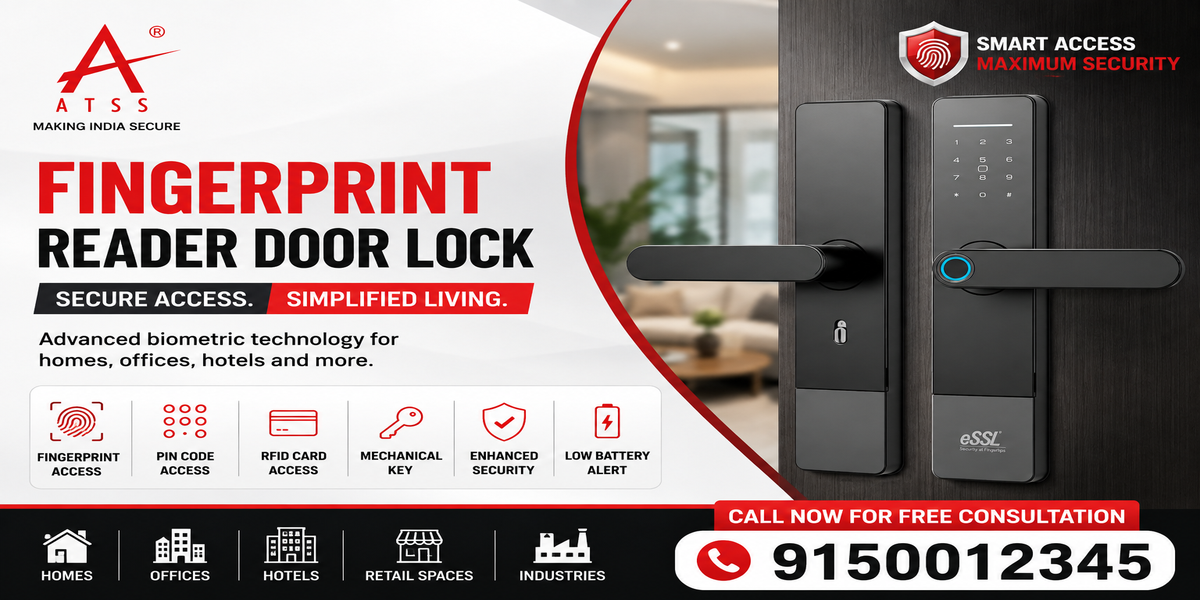
Fingerprint Reader Door Lock: A Complete Guide for Secure Access
A Fingerprint reader door lock offers a simple and secure way to control access without relying only on keys or cards.
These locks use fingerprints to verify authorised users and are ideal for homes, offices, hotels and commercial buildings. In addition, many models support cards, PINs or other access methods.
Therefore, when choosing a biometric door lock, consider security, user capacity, installation, authentication options and maintenance.
This guide explains how fingerprint door locks work, their benefits, types, common mistakes and key buying factors.
What Is a Fingerprint Reader Door Lock?
A fingerprint reader door lock is an electronic locking solution that uses fingerprint recognition to verify an authorised user before allowing access.
First, the user places a registered finger on the fingerprint sensor. Next, the reader captures the fingerprint pattern and compares it with the authorised biometric data stored in the system.
If the fingerprint matches, the system can release the electronic locking mechanism. However, if the fingerprint does not match an authorised record, access can remain locked.
Depending on the model, a fingerprint door lock may also support:
- Fingerprint authentication
- RFID or proximity cards
- PIN or password access
- Mechanical key override
- Multiple users
- Access event records
- Indoor exit buttons
- Remote or network-based management
Consequently, a door lock with fingerprint reader can provide both convenience and controlled access for different types of properties.
How Does a Fingerprint Reader Door Lock Work?
The operating process is simple for most users.
1. User Registration
First, an authorised administrator registers a user’s fingerprint in the system.
2. Fingerprint Authentication
When the user approaches the door, they place their registered finger on the reader.
3. Fingerprint Verification
The biometric reader analyses the fingerprint and compares it with the stored authorised template.
4. Access Decision
If the fingerprint is successfully verified, the system permits access.
5. Door Unlocking
The electronic lock releases the door for the configured period.
Therefore, the basic process is:
Register → Scan → Verify → Authorise → Unlock
In addition, some systems can record access events, making them useful for offices and other controlled environments.
Why Choose a Fingerprint Door Lock?
Traditional keys are simple, but they can be lost, copied or shared. Access cards can also be misplaced or transferred between people.
A fingerprint-based system addresses some of these challenges because the user’s biometric characteristic becomes the authentication method.
Key Benefits
Keyless Convenience
Users do not need to carry a physical key for fingerprint-based access.
As a result, daily entry can become faster and more convenient.
Improved Access Control
Only registered users can be authorised to open the protected door.
Therefore, businesses can maintain better control over restricted areas.
Reduced Key Management
There is no need to issue a separate physical key to every employee.
In addition, administrators can manage users according to the capabilities of the selected system.
Multiple Authentication Options
Many modern locks support more than one authentication method.
For example, a system may support:
- Fingerprint
- Card
- PIN
- Key
Consequently, the organisation can choose an authentication method based on its operational needs.
Suitable for Different Properties
Fingerprint access can be used in homes, offices, hotels, shops, warehouses and restricted commercial areas.
Fingerprint Card Reader Access Door Lock Control System Security Entry
For businesses, a fingerprint card reader access door lock control system security entry solution can provide a more structured approach to managing access.
For example, an office may allow employees to use fingerprints while providing cards to selected visitors or temporary users.
Similarly, a hotel or commercial facility may require different access permissions for staff, administrators and guests.
Depending on the system, access control can include:
- User registration
- Fingerprint authentication
- Card authentication
- PIN access
- Door lock control
- Access records
- User management
- Multiple access methods
Therefore, businesses should evaluate the complete access-control requirement rather than choosing a lock based only on its fingerprint reader.
Where Can Fingerprint Door Locks Be Used?
A fingerprint reader door lock can be useful across several applications.
Homes
Homeowners can use biometric locks for:
- Main entrances
- Bedrooms
- Private offices
- Home storage areas
- Restricted rooms
A fingerprint door lock for home use can provide convenient keyless entry.
Offices
Businesses can install biometric locks on:
- Main office entrances
- Server rooms
- Manager cabins
- Record rooms
- Restricted departments
In addition, access control can help organisations limit entry to sensitive areas.
Hotels
Hotels have specific access requirements. Therefore, hotel owners should consider locks designed for hospitality environments.
Applications may include:
- Guest rooms
- Staff areas
- Administrative rooms
- Storage areas
- Restricted facilities
A hotel fingerprint door lock may be useful where biometric authentication is required, although the appropriate solution depends on the hotel’s operational model.
Commercial Buildings
Fingerprint access control can also be used in:
- Retail stores
- Warehouses
- Clinics
- Educational institutions
- Corporate facilities
- Industrial buildings
Fingerprint Door Lock vs Traditional Key Lock
| Feature | Fingerprint Door Lock | Traditional Key Lock |
|---|---|---|
| Physical key required | Usually no | Yes |
| Biometric authentication | Yes | No |
| User management | Available on many models | Limited |
| Access cards | Available on selected models | No |
| PIN access | Available on selected models | No |
| Access records | Available on selected models | No |
| Multiple authentication methods | Often available | Limited |
| Electronic access control | Yes | No |
A traditional lock can still be suitable for simple applications. However, a fingerprint-based system provides additional functionality when controlled electronic access is required.
What Features Should You Check Before Buying?
Before choosing a fingerprint reader door lock, evaluate the following features.
Fingerprint Capacity
Check how many fingerprints the device can store. A residential lock may require fewer users, while an office may need considerably more.
Authentication Methods
Consider whether you need only fingerprints or a combination of:
- Fingerprint
- Card
- PIN
- Key
A multi-authentication system can provide greater flexibility.
Fingerprint Sensor
Sensor quality is important for reliable authentication. Therefore, check the sensor technology, authentication performance and operating conditions.
User Management
For offices and commercial properties, consider how users are added, removed and managed.
Access Records
If monitoring entry activity is important, choose a model that supports appropriate transaction or event storage.
Lock Compatibility
The reader is only one part of the solution. The lock body, door type, frame and installation conditions must also be compatible.
Power Backup
Electronic locks depend on power. Therefore, check whether the system provides suitable backup or emergency access options.
Installation Requirements
Before purchasing, confirm whether the door requires additional drilling, wiring or modifications.
Wired vs Standalone Fingerprint Door Locks
Not every fingerprint access solution works in the same way.
Standalone Fingerprint Door Lock
A standalone lock generally operates independently at the door.
It can be suitable for:
- Homes
- Small offices
- Private rooms
- Individual restricted areas
Therefore, standalone systems can be a practical option where centralised access management is not required.
Networked Access Control
A networked system can connect multiple access points to a central management platform.
This can be useful for:
- Large offices
- Hotels
- Factories
- Multi-door facilities
- Commercial buildings
As a result, administrators can have greater control over multiple doors and users.
Common Mistakes When Buying a Fingerprint Door Lock
1. Choosing Only Based on Price
A cheaper lock may not provide the required user capacity, authentication options or durability.
Instead, compare features with the property’s actual requirements.
2. Ignoring Door Compatibility
Not every lock fits every door.
Therefore, check door thickness, lock type, frame configuration and installation requirements before purchasing.
3. Choosing Too Little User Capacity
A small home may require only a few users. However, an office or hotel can require substantially more.
Therefore, select an appropriate user capacity from the beginning.
4. Ignoring Backup Access
Electronic systems can depend on power and electronics.
For this reason, check emergency power and backup unlocking options before installation.
5. Forgetting Future Requirements
Your access requirements may grow over time.
Consequently, choosing an expandable solution can make future upgrades easier.
6. Poor Installation
Even a high-quality lock can perform poorly if it is incorrectly installed.
Therefore, professional installation is recommended for commercial and critical applications.
How to Choose the Best Fingerprint Reader Door Lock
Before making a purchase, answer these questions:
What type of property needs protection?
A home, office and hotel will have different access requirements.
How many users need access?
Determine the expected number of authorised users and future users.
Do you need card access?
If employees or visitors may require cards, consider a multi-authentication model.
Do you need access records?
Businesses may benefit from transaction records for monitoring and administration.
Is the door compatible?
Check the physical door and lock requirements before selecting the product.
Do you need multiple doors?
If you need to control multiple entry points, a networked access control system may be more appropriate than independent locks.
What happens during a power failure?
Always consider emergency access and backup power requirements.
Fingerprint Reader Door Lock for Chennai and India
The Indian market includes homes, offices, hotels, retail stores and commercial facilities with very different security requirements.
In Chennai, properties may range from compact offices and apartments to large commercial buildings and hospitality facilities.
Therefore, the ideal fingerprint access solution should be selected according to:
- Property type
- Door configuration
- Number of users
- Required authentication methods
- Environmental conditions
- Security requirements
- Installation requirements
- Future expansion
For commercial projects, a professional security provider can assess the site and recommend the appropriate lock or access-control configuration.
Expert Recommendation
A fingerprint door lock should not be selected simply because it has biometric authentication.
Instead, evaluate the complete access-control solution.
For a small home, a standalone fingerprint lock may be sufficient. On the other hand, an office with several restricted rooms may require a networked access control system.
Similarly, hotels may require hospitality-specific electronic locking solutions rather than a standard residential biometric lock.
Therefore, the best solution is the one that matches your property, users and security objectives.
A professional security provider can help assess the door type, access requirements and future expansion needs before installation.
Frequently Asked Questions
What is a fingerprint reader door lock?
A fingerprint reader door lock is an electronic lock that uses fingerprint authentication to verify authorised users before allowing entry.
Is a fingerprint door lock secure?
A fingerprint lock can provide controlled biometric access. However, overall security also depends on the lock quality, installation, authentication settings, physical door and supporting security measures.
Can a fingerprint door lock also use a card?
Yes, some models support multiple authentication methods, including fingerprints, RFID cards, PINs and mechanical keys. The available options depend on the specific model.
Are fingerprint door locks suitable for offices?
Yes. Fingerprint door locks can be suitable for offices, particularly for restricted rooms and controlled entry points. For larger offices, a networked access control system may provide additional management capabilities.
Can fingerprint door locks be used in hotels?
Some fingerprint-based solutions can be used in hospitality environments. However, hotel owners should select a system specifically suited to guest management, room access and hotel operating requirements.
Conclusion
A fingerprint reader door lock provides a convenient way to combine electronic locking with biometric authentication.
Instead of relying entirely on traditional keys, users can gain access using registered fingerprints. In addition, selected models can support cards, PINs and other authentication methods.
For homes, offices, hotels and commercial buildings, the right solution depends on user capacity, door compatibility, authentication requirements, access records, power backup and future expansion.
Therefore, before purchasing a door lock with fingerprint reader, evaluate the complete security requirement rather than focusing on one feature.
With the right product and professional installation, biometric access control can become an effective part of a modern property security strategy.
📞 Call ATSS Today
Looking to install fingerprint reader door lock chennai?
Call / WhatsApp: 9150012345
Get a free demo, expert consultation, and best price today.
Door Access Control | Face Recognition System | Fingerprint Attendance Systems | Biometric Attendance Machine | Biometric Attendance System in Chennai | Fingerprint Scanner Door Lock